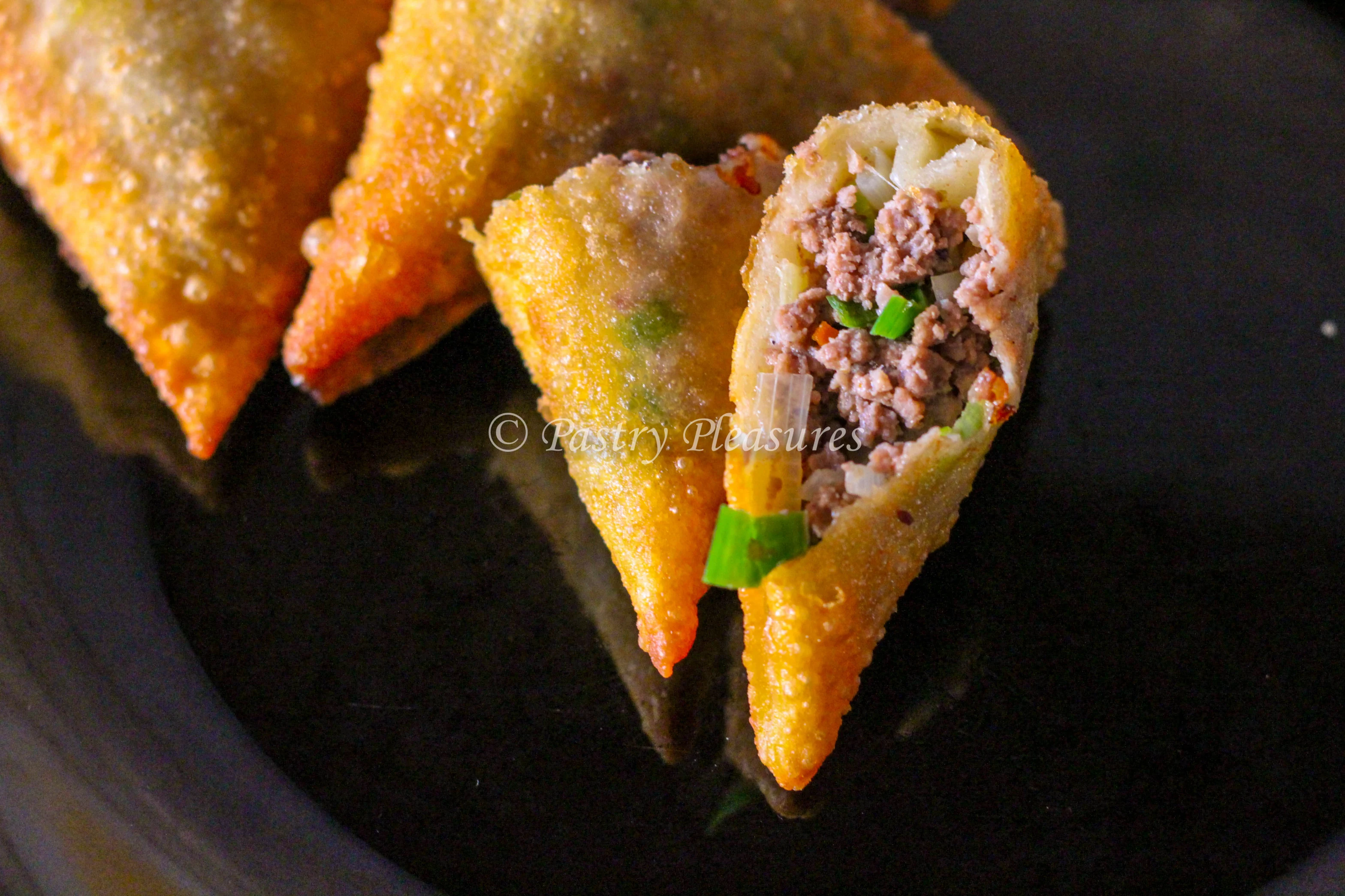
Ingredients
Stuffing
- 500g minced beef
- 1 – 2medium sized Leek onion
- Spices (optional)
- Salt (to taste)
- Chillies (optional)
Manda
- 500g flour plus extra
- Water
- Oil
Method
Start with preparing your meat. Cook the minced meat to suit your taste. If using spices, use them sparingly as the Leek onion gives a wonderful taste.

Once the minced meat is ready, slice the leek onion thinly and add to the beef. Remember. Do not cook the onions as they will end up losing their flavour upon deep frying.

Add your chilli (again the amount is based on your personal preferences)

I always separate my meat into two portions as my sister does not like too much chilli in her samosa.

Set aside.

Getting your manda ready
In a bowl, mix together the flour and water, mix it well until it becomes a dough. You should be able to knead the dough without it sticking onto your hands or onto the surface. If still sticky, dust a little bit of flour onto the surface and continue kneading.

When the dough is ready, divide it into five (5) equal balls. A general rule I learnt from one of my students is that for every kilo of meat you use while making samosas, you’ll require a kilo of flour. (I was making more than 60 samosas)

Half a kilo of meat (500g) should make a minimum of 20 samosas.

Roll the balls into small equal circles. Stack them together using a small amount of cooking oil between the layers.

When all five are stacked, dust your surface with flour and roll into one piece of chapati. Flip it constantly to ensure both sides are evenly rolled. When the manda is thin enough and feels like One chapati, cut about half an inch off of the outer edge. You can use a plate or your pan size to cut it into a perfect circle.
Here comes the fun part
Heat up your pan. We use this heavy duty pan that my mother has sworn by and i also attest to.

Pan should be clean with no oil.
When the pan is hot, place the rolled layers onto the pan, rotating to ensure even heat distribution. Flip after ten (10) to twenty (20) seconds to ensure both sides are well heated. Don’t let them brown. Remove them from the pan and peel off the two pieces that you’ve heated, as shown below. Do this with all sides to ensure all are well done.
The heating of the manda ensures that it folds easily without tearing.
Place the heated pieces on top of each other and cut into four equal pieces (quarters). They should resemble triangles

Making the samosa pockets
Make a paste with flour and water, ensuring that the paste is heavy and not runny.

Take one leaf and apply the paste on half of the outer side.

Fold the side without the paste into half like so,

Bring the other half with the paste to close, pressing lightly to ensure it seals. You Can do this with all your quarters first, so as to ensure there is an even distribution of the stuffing. They should look like so:-

Stuff the pockets.

Tuck in the shorter side, where the two folds meet, into the stuffing,

Apply paste to the open side,

Seal the pockets.

When all the pockets are stuffed and sealed, you can freeze them for up to a month, or deep-fry them then freeze.

When deep-frying, ensure that the oil is hot and clean, before putting the samosas into the oil. The oil should bubble up when the samosas are dropped into the oil. They should turn golden brown on both sides before removing them from the oil.

Serve them when warm! Enjoy